Newsletter Subscribe
Enter your email address below and subscribe to our newsletter
Enter your email address below and subscribe to our newsletter

All voices matter
The financial world is currently vibrating with a figure that sounds like lunacy: $8,400 per ounce. When JPMorgan leaked snippets of a specialized quantitative model suggesting gold could triple from its current “record highs,” the retail market scoffed. But if you are staring at the K-line charts wondering if the “top is in” at $2,700 or $3,000, you are looking at the wrong map. You are tracking price action; the giants are tracking systemic solvency.
This isn’t just a bullish forecast. It is a post-mortem on the US Dollar’s era of undisputed hegemony. Here is the cold, hard logic behind the “The $8,400 Balance Point.”

The bedrock of JPMorgan’s thesis isn’t sentiment—it’s a supply-demand choke point. Their quantitative team identified a “Magic Number”: 380 tons per quarter.
In a digitized world, we forget that gold is a physical element governed by the laws of thermodynamics. You cannot “Print to Click” a gold bar.
| Supply Component | Status | Impact on Price |
| Annual Mine Production | Stagnant (~3,500 tons) | Cannot scale quickly regardless of price. |
| Recycled Gold | Price Sensitive | Only enters the market during extreme spikes. |
| Central Bank Action | Net Buyers | Removing physical supply from the circulating float. |
The Math: When global institutional and sovereign demand exceeds 380 tons per quarter, the price doesn’t just rise; it enters a “vertical squeeze.” Currently, the world is trying to shove $100 billion of fiat liquidity per quarter into a physical hole that only fits 380 tons. To make $100 billion equal 380 tons, the price must mathematically reset toward $8,000+.
For forty years, the “Gold Rule” was simple: When real interest rates (yield minus inflation) go up, gold goes down.
That rule is dead. We are witnessing a “de-parenting” of gold from the US Dollar. In 2023 and 2024, despite the Federal Reserve maintaining “higher for longer” rates, gold continued to smash records. Why? Because the world’s largest buyers—Central Banks in the East—no longer care about the yield on a “IOU” (US Treasuries) that can be frozen or devalued at the touch of a button.
“Gold is not rising because it’s a good investment. It’s rising because the paper it’s measured in is failing as a store of value.”
We are currently in the middle of the largest Global Asset Reallocation in 55 years. Since the freezing of Russian FX reserves, every sovereign nation has realized that “money” held in a foreign bank is merely a “permission-based gift.”
JPMorgan’s report suggests that if only 5% of the global bond market rotates into physical gold, there isn’t enough gold on the planet to satisfy the demand at current prices. The price of $8,400 is essentially the “Curb Price” required to stop the stampede.
Critics point to the 1980 or 2011 peaks as proof of “bubbles.” However, the structural integrity of this rally is different:
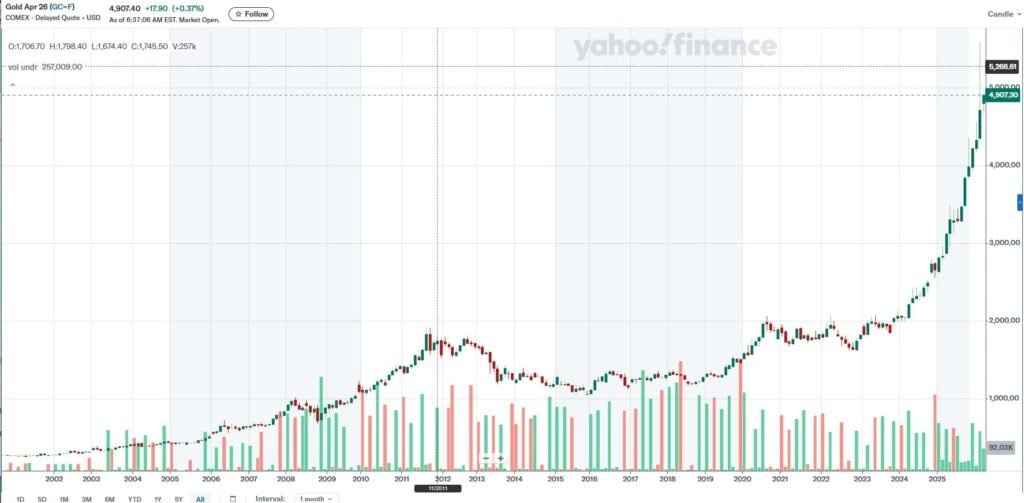
If you are waiting for a “dip” back to 2020 levels, you are betting on the resurrection of a global credit system that is already on life support. The $8,400 target isn’t a “get rich quick” scheme for speculators—it is a mathematical re-rating of what a currency is worth when the issuer has overextended its credit.