Newsletter Subscribe
Enter your email address below and subscribe to our newsletter
Enter your email address below and subscribe to our newsletter

All voices matter
The dramatic arrest of Nicolás Maduro by U.S. forces in early 2026 has reignited a perennial debate in global financial circles: Did China’s massive bet on Venezuela finally go up in smoke? For years, headlines have screamed about a “$60 billion loss” or “loans gone to die.”
However, a cold-blooded analysis of debt structures, refinery physics, and the latest bond market movements reveals a paradox. Far from a total loss, China’s exposure is shrinking, its remaining debt is arguably more secure than Western bonds, and the U.S. intervention may have inadvertently performed a “credit upgrade” for Chinese interests.

To understand the current stakes, we must separate cumulative lending from outstanding balance. Between 2007 and 2016, China indeed extended roughly $60 billion in credit to Venezuela. Critics often frame this total sum as “the loss.”
In reality, the vast majority of these loans were structured as oil-for-loan agreements. This means repayment wasn’t dependent on Venezuela’s empty treasury, but on its underground reserves. According to data from AidData and current 2026 financial assessments, the outstanding debt has been whittled down significantly through a decade of consistent, albeit discounted, oil shipments.
| Metric | Estimated Value (2026) | Significance |
| Total Cumulative Lending | ~$60 Billion | The historical peak of exposure (2010-2016). |
| Current Outstanding Debt | $12B – $19B | Represents only ~10% of Venezuela’s total external debt. |
| Debt Type | Commodity-Backed | Repaid in physical crude, bypassing the SWIFT system. |
| Repayment Status | Active (Amortizing) | Unlike Western bonds, China has received regular “installments.” |

A common misconception is that Venezuela’s “dirty” heavy oil is a liability. For a standard gasoline refinery, it is. But for China’s massive infrastructure engine, it is a strategic asset.
Venezuela’s Merey-16 grade is high in asphalt content. During China’s infrastructure boom, this crude became the literal foundation of thousands of miles of Chinese highways.

The most ironic twist of the 2026 crisis is the reaction of the bond markets. When the U.S. launched its operations and captured Maduro, Venezuelan sovereign bonds didn’t crash—they skyrocketed.
Historically, Venezuelan debt traded as “distressed junk” at roughly 6 to 10 cents on the dollar. Following the U.S. intervention, these bonds jumped to over 30 cents.
Market Logic: Capitalists bet that a U.S.-backed transition will lead to a massive debt restructuring. If the new government wants to return to the global economy, it must settle its debts.
For China, this means the “market value” of their remaining $17 billion in claims has technically improved. If a new administration in Caracas seeks legitimacy, they cannot simply default on China. Why? Because the U.S. doesn’t want the oil.
The U.S. is currently a net exporter of oil. Its refineries are largely optimized for the light, sweet crude produced by the Permian Basin shale revolution. They have little appetite for 800,000 barrels per day of Venezuelan sludge.
China, however, remains the world’s largest importer.
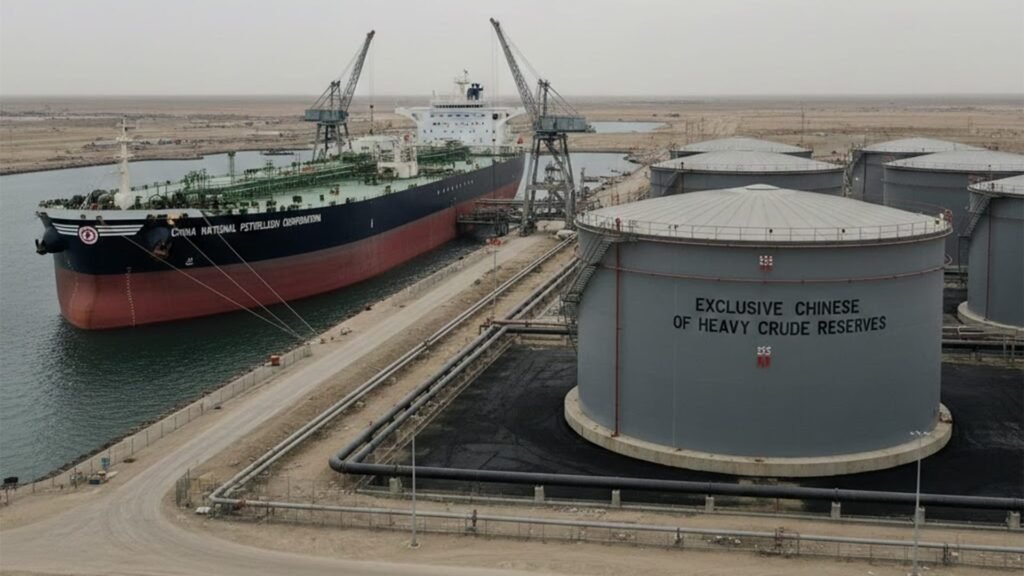
Is China “losing money” in Venezuela? On a pure cash-flow basis, the ROI is lower than a standard bank loan. But as a strategic energy play, it has been a success:
Regardless of who sits in the Miraflores Palace, the reality remains: Venezuela has the oil, China has the refineries, and the U.S. has the debt-collection headache. For Beijing, the “void” is actually a very calculated, very tangible reservoir of energy.