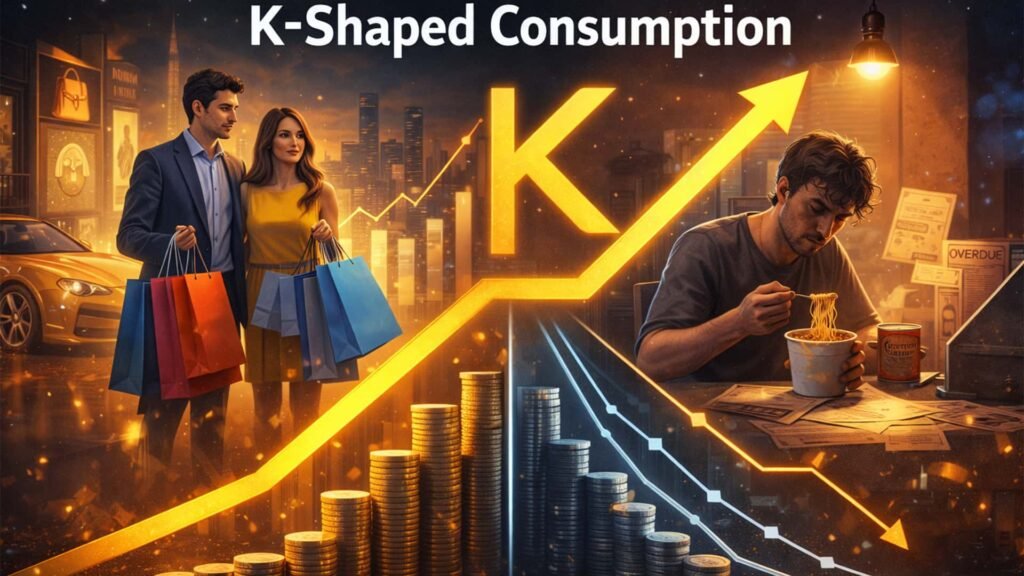
K-Shaped Consumption refers to a consumption pattern in which different income or social groups move in opposite directions under the same economic environment, forming a divergence that resembles the letter “K.”
K Shaped Consumption
1. Core Definition (in one sentence)
K-Shaped Consumption describes a situation where
high-income and asset-owning consumers continue to upgrade their spending, while middle- and lower-income consumers reduce or downgrade consumption, leading to structural divergence rather than synchronized growth or decline.
2. What Do the Two Branches of the “K” Represent?
Upward Branch (↑)
Who they are:
High-income households
Asset beneficiaries (stocks, real estate, equity, technology gains)
Consumption characteristics:
Growth in luxury and premium services
Spending on high-end travel, healthcare, education, and AI tools
Low price sensitivity
Focus on experience, efficiency, and status signaling
Typical industries:
Luxury goods (LVMH, Hermès)
Premium consumer electronics (Apple Pro series)
Private healthcare and international education
High-end subscription and membership services
Downward Branch (↓)
Who they are:
Middle- and lower-income households
Workers with unstable employment
Highly leveraged or asset-poor consumers
Consumption characteristics:
Consumption downgrade and strong price sensitivity
Delayed or reduced discretionary spending
Preference for discounts, private labels, and substitutes
“Spend only what is necessary”
Typical industries:
Discount retail
Value-focused platforms (e.g., dollar stores, low-price e-commerce)
Second-hand and rental economy
Low-cost fast-moving consumer goods and instant food
3. How K-Shaped Consumption Differs from Traditional Economic Cycles
Dimension
Traditional Cycle
K-Shaped Consumption
Consumption direction
Rise and fall together
Divergence by income tier
Primary driver
Macroeconomic growth
Asset distribution + technology dividends
Role of the middle class
Core growth engine
Squeezed segment
Corporate strategy
Scale expansion
Precise segmentation and pricing power
Key insight: K-Shaped Consumption is structural, not cyclical.
4. Root Causes of K-Shaped Consumption
1) Asset price divergence
Rising equity and asset prices enrich asset holders
Wage growth lags, eroding purchasing power for salaried workers
2) Concentration of technology dividends
AI and platform economies amplify winner-take-most dynamics
Bargaining power of routine labor declines
3) Inflation and interest-rate pressure
Cost-of-living increases disproportionately hit lower incomes
Wealthier households hedge through assets
4) Labor market polarization
High-skill jobs command rising premiums
Middle- and low-skill roles face automation pressure
5. Real-World Examples
Luxury brands post record profits while mass-market consumption weakens
Premium travel and resorts are fully booked, while budget dining struggles
Strong sales of iPhone Pro models alongside intense price competition at the low end
Subscription and membership services grow as one-off discretionary purchases decline
6. Implications for Investors and Businesses
For investors
Avoid “middle-of-the-road” companies with weak pricing power
Focus on the two ends:
Premium brands with strong moats
Ultra-low-cost players with scale and efficiency advantages
For businesses
Ambiguous positioning is risky
Companies must clearly decide:
Which side of the K are we serving?
7. One-Sentence Summary
K-Shaped Consumption is not about weaker demand—it is about demand being reallocated.
Money has not disappeared; it has concentrated in specific consumer groups, products, and business models.