Newsletter Subscribe
Enter your email address below and subscribe to our newsletter
Enter your email address below and subscribe to our newsletter

All voices matter
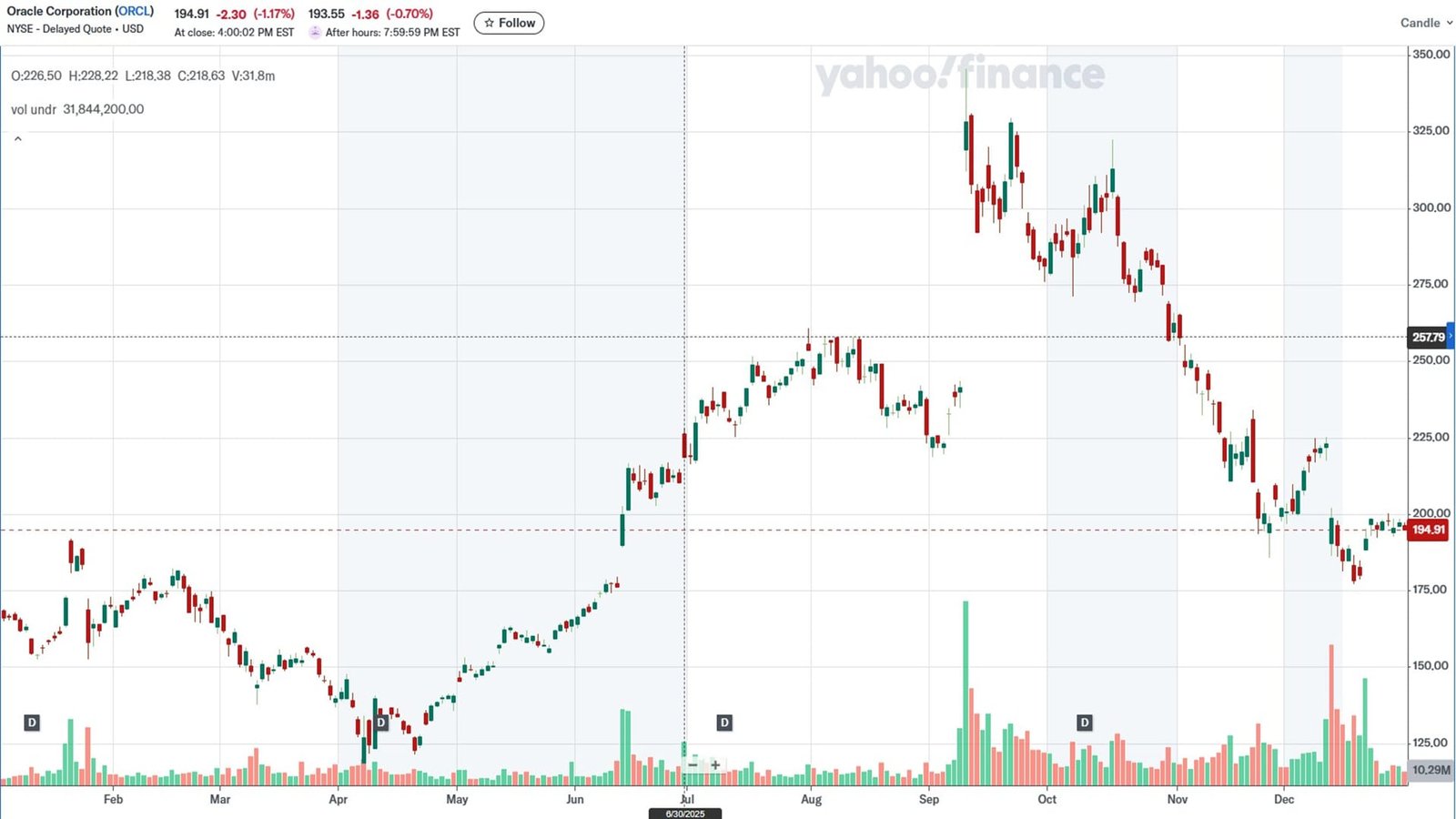
If you’ve been tracking tech stocks lately, Oracle’s recent nosedive probably caught your eye—and maybe even your portfolio. Shares tumbled 17% in just one week, extending a near-50% drop from recent highs, as the company’s latest earnings report sparked a market meltdown. As someone who’s spent over 15 years analyzing enterprise software and cloud giants, I’ve seen my share of hype cycles and corrections. This isn’t just another blip; it’s a wake-up call for anyone betting big on AI infrastructure. But is it a full-blown collapse, or a setup for a rebound? Let’s dig in, with hard data and real-world context, to help you decide if it’s time to buy the dip or bail out.
The drama kicked off with Oracle’s fiscal second-quarter results for 2026, released in mid-December 2025. On paper, there were bright spots: Total revenue hit $16.1 billion, up 14% year-over-year, with cloud revenue (IaaS and SaaS combined) surging 34% to $8 billion. The remaining performance obligations (RPO)—a key backlog metric—exploded 438% to $523 billion, fueled by massive deals with AI heavyweights like Meta and Nvidia.
But Wall Street fixated on the misses. Revenue fell short of the $16.2 billion consensus, and free cash flow plunged to a shocking negative $10 billion—double the expected negative $5.2 billion. Worse, Oracle hiked its FY2026 capital expenditure guidance by $15 billion to $50 billion, signaling an all-in bet on AI data centers that’s straining the balance sheet. Debt has ballooned to over $100 billion, pushing credit default swaps to levels not seen since 2009. Investors aren’t buying the “growth at any cost” story anymore; they’re demanding proof that these billions will translate to profits soon.
From my vantage point, this reaction feels overdone in the short term but rooted in legitimate long-term worries. Oracle’s cloud infrastructure margins came in at just 14%, far below the 30-40% the company projected earlier. It’s a classic case of front-loaded spending clashing with delayed revenues—especially when tied to high-profile partners like OpenAI.
To make sense of this, let’s look at the numbers side by side. I’ve pulled together a comparison of Oracle’s key Q2 FY2026 metrics against analyst expectations and prior-year figures. This table highlights why the market freaked out, but also spots potential undervaluation if execution improves.
| Metric | Q2 FY2026 Actual | Analyst Consensus | YoY Change | Key Insight |
|---|---|---|---|---|
| Total Revenue | $16.1B | $16.2B | +14% | Solid growth, but miss drags sentiment amid AI hype. |
| Cloud Revenue (IaaS + SaaS) | $8.0B | $8.1B (implied) | +34% | AI-driven surge, yet margins disappoint at 14%. |
| Remaining Performance Obligations (RPO) | $523B | $502B | +438% | Massive backlog signals demand, but conversion timing uncertain. |
| Non-GAAP EPS | $2.26 | $1.64 | +54% | Big beat, boosted by one-time gains like Ampere sale. |
| Free Cash Flow | -$10B | -$5.2B | N/A | Double the expected burn; debt-fueled capex red flag. |
| FY2026 Capex Guidance | $50B | $35B (prior) | +43% | Upward revision spooks investors on ROI timeline. |
| Net Debt | $108B | N/A | +High | CDS spreads at 151 bps; junk status risk looms. |
Source: Oracle earnings release and analyst compilations from LSEG/StreetAccount.
What jumps out? The RPO figure is a monster—proof that AI demand isn’t fading. Oracle’s locked in over 700 clients, including non-OpenAI names like Meta and AMD, diversifying beyond that one risky bet. But the cash flow hemorrhage and capex spike scream “execution risk.” Oracle’s operating 147 data centers with 64 more in the works, outpacing rivals, yet delays in OpenAI-linked projects (pushed to 2028) are fueling doubts. In my experience, these mismatches often lead to short-term pain but long-term gains if the company navigates the debt crunch.
Oracle’s woes aren’t isolated—they’re amplifying fears across the AI ecosystem. The market’s been gorging on AI infrastructure plays, with hyperscalers like Microsoft and Amazon pouring trillions into data centers and GPUs. But 2026 projections show capex potentially topping $500 billion industry-wide, with profitability lagging. Oracle’s $300 billion OpenAI deal exemplifies the risk: If OpenAI can’t pay up (its revenue is just $13 billion annually), Oracle’s exposed to massive write-downs.
Social media chatter on X (formerly Twitter) echoes this sentiment. Users point to “circular financing” where Nvidia funds OpenAI, who buys from Oracle, who buys Nvidia chips—creating a house of cards. Broader AI concerns include energy bottlenecks, commoditizing GPU rentals, and margin compression as supply catches demand. Yet, optimists like me see this as a maturation phase: AI isn’t bursting; it’s shifting from hype to hard economics. Productivity gains could still drive 15-20% market growth in 2026, per some forecasts.
So, is this a technical correction or the start of a rout? From my perch, it’s more the former. Oracle’s trading at a forward P/E of around 25x—cheaper than peers like Microsoft (35x)—with a 1.4% yield and buybacks on tap. The stock’s 30% quarterly drop is its worst since 2001, but history shows such overreactions often precede rebounds if fundamentals hold.
That said, risks are real: Rising debt could force equity dilution, and if AI ROI disappoints, more pain awaits. For investors, diversify—pair Oracle with less capex-heavy AI plays like software-focused firms. If you’re aggressive, buy on weakness below $200, targeting $300+ by year-end if backlog converts. Conservative types: Wait for FCF positivity in Q3.
Oracle’s crash underscores a pivotal 2026 theme: AI’s promise versus its price tag. The company’s got the orders and the edge in multicloud tech, but execution will make or break it. Don’t panic-sell; assess your risk tolerance and timeline. If AI’s structural shift holds—and I believe it will—this could be the discount you’ve been waiting for. What’s your move? Share in the comments—let’s discuss.