
Newsletter Subscribe
Enter your email address below and subscribe to our newsletter
Enter your email address below and subscribe to our newsletter

All voices matter
While many institutional forecasts are hedging their bets with “wait-and-see” rhetoric, UBS has broken formation. Their 2026 outlook is arguably the most aggressive roadmap we’ve seen, projecting a 15% global equity surge and a total re-rating of what “value” looks like in a post-AGI world.
This isn’t just about picking stocks; it’s about a structural shift in global capital. If you are managing a portfolio today, the “standard” 60/40 split might be your biggest risk. Here is how the smart money is positioning for 2026.
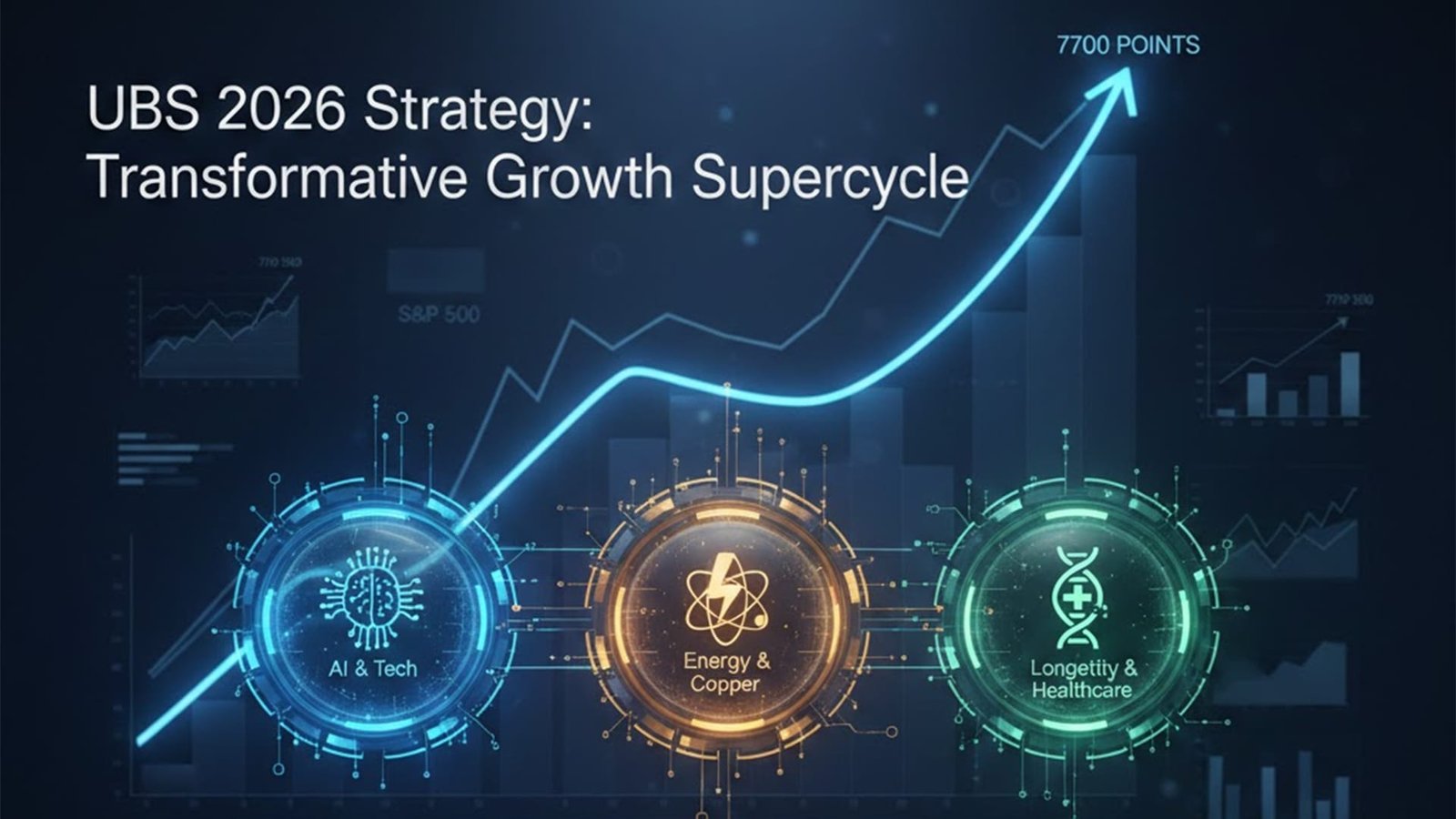
UBS identifies three “engines” that are no longer just sectors—they are the new foundations of the global economy.
The narrative has shifted from “Can AI chat?” to “Can AI work?” UBS estimates that by 2030, the demand for computing power from AI Agents (autonomous software that performs tasks) will be 120x that of 2024.
We are currently in the “Capex Phase.” Critics argue that Big Tech is overspending, but historical data on the Industrial and Internet revolutions shows that current AI capital expenditure as a percentage of global GDP is still in its infancy.

You cannot have a digital revolution without a physical one. The AI infrastructure boom has triggered a secondary crisis: Energy Scarcity. * The Play: Power utilities and Copper miners.
Unlike AI, which relies on technical breakthroughs, the “Longevity” engine relies on undeniable math: aging demographics. UBS highlights GLP-1s (diabetes/obesity) and oncology as the most “defensive” growth plays, with projected annual growth rates of 8% to 12%.
Investors often mistake “innovation” for “profitability.” UBS’s 2030 value distribution model suggests a significant shift in where the alpha resides.
| Layer | Market Share | Primary Beneficiaries | Strategic Outlook |
| Enabling Layer | 53% | Semis (NVIDIA/TSMC), Infrastructure, Cloud | The “Lords of the Toll Road.” Highest immediate margins. |
| Intelligence Layer | 16% | LLM Providers (OpenAI, Anthropic, Google) | High competition; potential “race to the bottom” on pricing. |
| Application Layer | 31% | AI Agents, Robotics, Enterprise SaaS | The “Long Tail” of growth. This layer will expand post-2030. |
Analyst Note: While the Enabling Layer (hardware) is the current winner, the real “multi-baggers” of 2026 will likely emerge from the Application Layer as companies successfully monetize AI agents.
UBS isn’t just bullish on the US; they are looking for “Mean Reversion” in ignored markets.
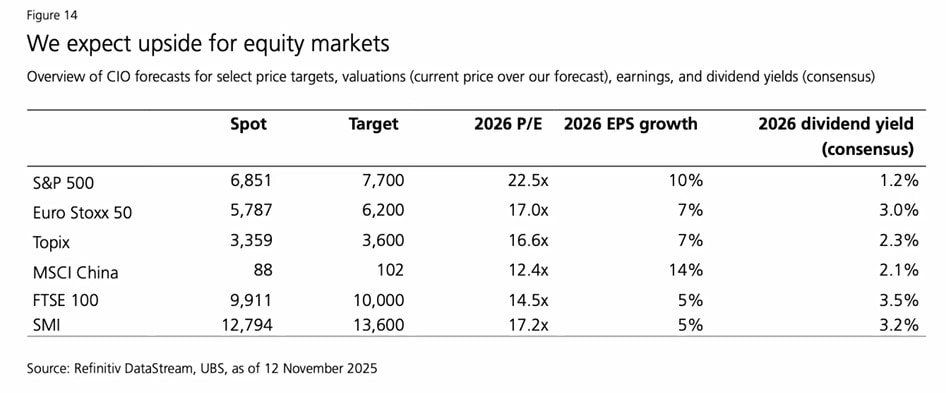
The most controversial part of the UBS report is their stance on “Overweighting.” They suggest that a standard global index (ACWI) is no longer enough.
The Strategy:
Investment isn’t a one-way street. UBS identifies four interconnected risks that could derail the 2026 bull run:
To hedge these risks, the report suggests a diversified “Safety Net”:
The 2026 outlook from UBS is a clarion call for “Structural Optimism.” The transition from the “Information Age” to the “Intelligence Age” is creating a capital-intensive cycle that favors those who own the infrastructure and the application.



[…] Decoding UBS 2026 Strategy for a “Transformative Growth” Supercycle […]