Newsletter Subscribe
Enter your email address below and subscribe to our newsletter
Enter your email address below and subscribe to our newsletter

All voices matter
If you moved all the gold and silver in the world into one country’s vaults, would its people necessarily eat better, live in better homes, and enjoy more prosperous lives?
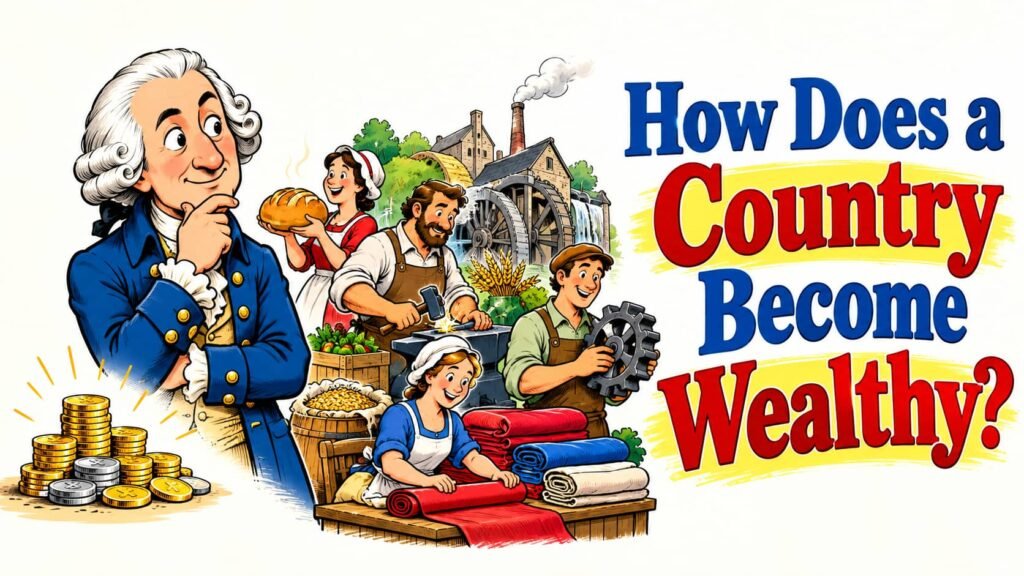
More than two hundred years ago, Adam Smith wrote a book that took a fresh look at where wealth comes from. That book was The Wealth of Nations, whose full title is An Inquiry into the Nature and Causes of the Wealth of Nations.
The questions it explores are closely connected to our everyday lives. Why do some places offer plenty of job opportunities, while in others it’s hard to find a career that suits you? Why does the price of a product rise and fall? And why can a society become wealthier even when everyone is trying to earn money for themselves?
To understand these questions, let’s return to something more fundamental: what exactly is wealth?
In Smith’s time, European economic policy was heavily influenced by mercantilism. One of its central ideas closely linked a country’s wealth to the accumulation of gold and silver.
According to this thinking, a country that wanted to grow rich should sell more to other countries and buy less from them. Exports brought in gold and silver, while imports spent them. As long as you sold more than you bought, precious metals would keep flowing into your country.
So governments restricted imports with high tariffs, encouraged exports with subsidies, and sometimes even banned gold and silver from leaving the country. Which goods could enter, and whom merchants could trade with, might both be strictly controlled.
Smith argued that this approach confused the means of payment with the things people actually needed to live.
Gold and silver can be used in exchange, but they can’t directly meet every need. When you’re hungry, you need food. When it’s cold, you need clothing and shelter. To make production more efficient, you need tools and machinery.
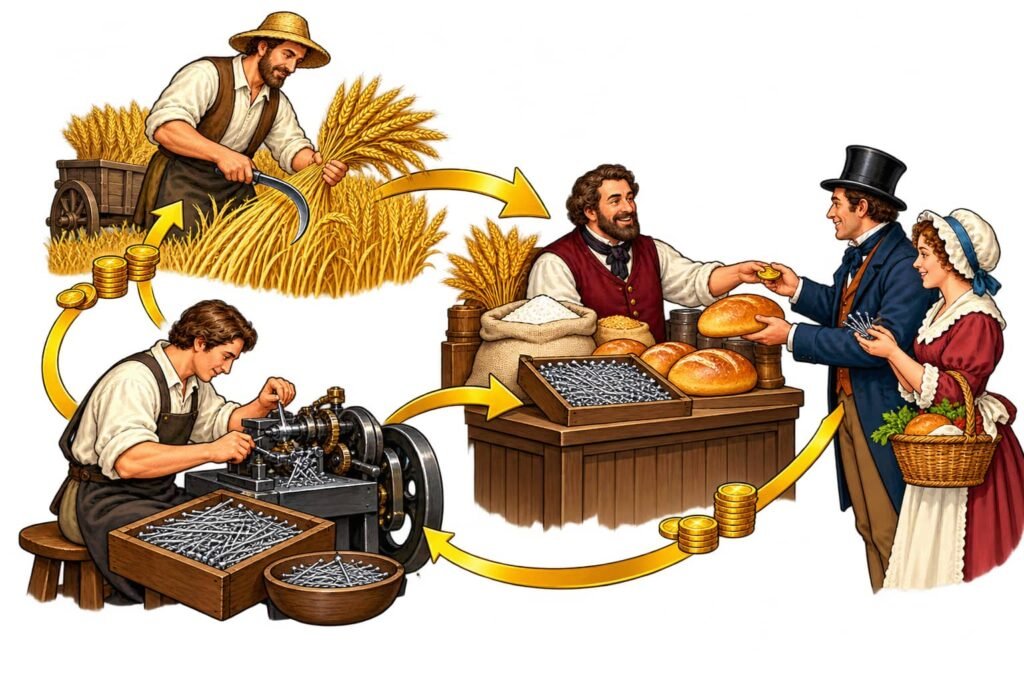
If the supply of those things doesn’t increase, filling the vaults with more gold and silver doesn’t necessarily improve people’s lives.
In Smith’s account, the key to understanding a nation’s prosperity was what its land and labor produced each year, together with the necessities of life that could be obtained in exchange for those products. To measure wealth, we need to look at how many necessities and conveniences a society can keep providing, and how many people those goods can support.
Money is like a wheel that helps goods circulate. Keeping that wheel turning smoothly matters, but what we ultimately need is the food, clothing, and other everyday goods it brings us.
The experiences of Spain and Portugal help illustrate this distinction. Both obtained large quantities of gold and silver through their colonial systems in the Americas, and both tried to keep those metals at home through bans and restrictions.
But access to precious metals didn’t guarantee a corresponding increase in domestic productive capacity. Smith also pointed out that when the gold and silver flowing in exceeded what a country actually needed, even the strictest bans struggled to stop those metals from flowing elsewhere.
A country’s rise or decline involves many factors, including institutions, wars, production, and trade. It can’t simply be attributed to hoarding gold and silver. But one thing is clear: an inflow of precious metals doesn’t automatically become more plentiful food, better tools, or a higher standard of living.
If the amount of goods available to buy doesn’t increase accordingly, more money can also show up as higher prices.
At the time, another influential school of thought had emerged in France, known as physiocracy.
The Physiocrats placed agriculture at the center of the economy. They believed that land yielded a net product beyond the resources put into production, while manufacturing and commerce mainly processed and moved products that already existed.
In this theory, agriculture was regarded as the main source of net wealth, while manufacturing and commerce were assigned to what was called the unproductive class.
Smith rejected the idea that wealth creation was confined to agriculture.
A carpenter turns wood into a table. A blacksmith turns metal into farming tools. Textile workers turn raw materials into clothing. Their work changes what those materials can be used for and adds to the products people can use and exchange.
And agriculture, manufacturing, and commerce have always depended on one another. Farmers need blacksmiths to make tools, merchants to transport supplies, and other industries to provide clothing and everyday goods. The food farmers produce, in turn, feeds the people working in those industries.
One kind of work supports another, allowing society’s productive capacity to gradually grow.
This changes the question. If wealth comes through production and exchange, how can the same number of people produce more in the same amount of time?
Smith’s first major answer was the division of labor.
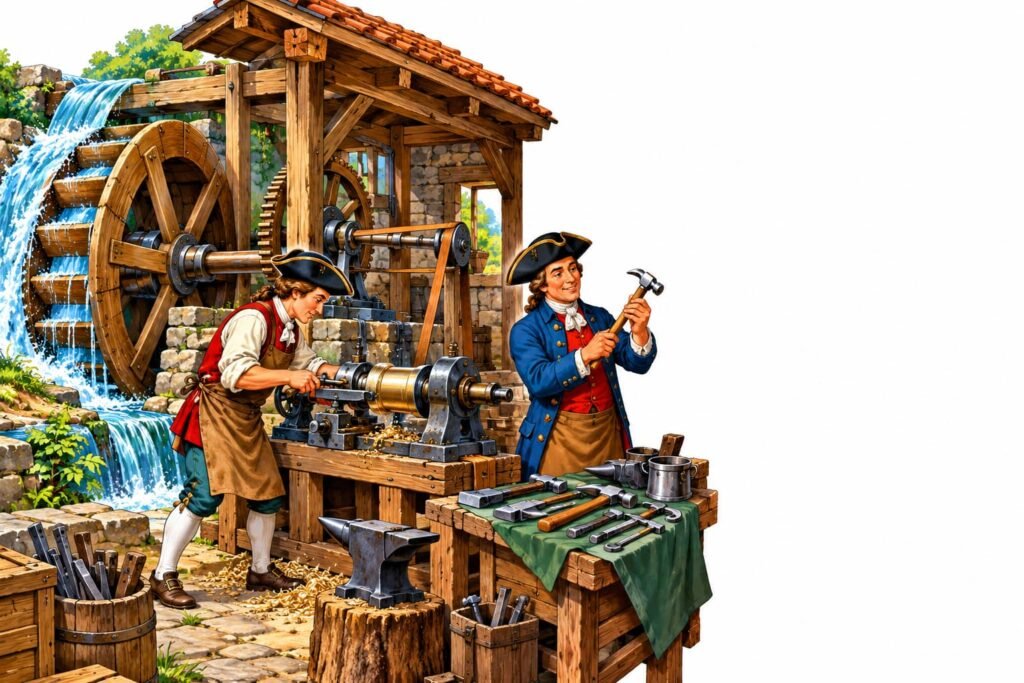
The Wealth of Nations opens with a pin factory.
A tiny pin doesn’t look particularly complicated. But ask someone who has never learned to make pins and isn’t familiar with the tools to carry out every step alone, from beginning to end, and their output would be very limited.
Smith estimated that even a very hardworking person in that position might struggle to make a single pin in a day, and certainly couldn’t make twenty.
Divide up the production process, and the situation changes.
One person draws out the wire. Another straightens it. Another cuts it. Someone else sharpens the point, while others make the heads, attach them, and package the finished pins.
In the process Smith described, making a pin could be divided into about eighteen separate operations. Some factories assigned these to different people, while smaller factories had one person handle two or three of them.
Smith said he had seen a small factory with just ten workers and equipment that was far from ideal. Yet when those workers were fully occupied, they could together produce around forty-eight thousand pins in a day.
That works out to forty-eight hundred pins per person.
The people were the same, and the day hadn’t become any longer. What made such a dramatic difference in output was how their work was organized.
Why does the division of labor improve efficiency? Smith gave three reasons.
First, it helps workers become more skilled.
When someone repeats the same operation, they gradually master its details. They become better at holding the tool, controlling the force they apply, and judging whether the material meets the requirements.
Movements that once required careful thought gradually become reliable routines. That saves time and reduces mistakes.
Second, the division of labor reduces the time lost when switching between tasks.
If someone finishes drawing out wire, changes tools to sharpen the points, then moves on to making heads and preparing the packaging, they have to keep changing the way they work.
Changing tools takes time. So does getting back into the rhythm of a different task. If the work takes place in different areas, there’s also the time spent walking back and forth. Each delay may seem small, but together they affect the entire day’s output.
Keeping workers focused on relatively fixed operations reduces that repeated switching.
Third, the division of labor can also encourage improvements in tools and machinery.
When someone spends a long time concentrating on a particular problem, they’re more likely to notice possibilities. Could this movement be eliminated? Could this step be made simpler? Could some device take over this repetitive operation?
Smith tells a story about an early steam engine that required someone to operate its valves repeatedly. A boy assigned to this job found a way to connect a valve to other parts of the machine with a cord, so the machine’s own movement would open and close it.
In this story, the boy improved the way an existing machine was operated. Smith used it to show how the everyday desire to save effort could also lead to technical improvements.
More complex improvements also require the combined work of machine makers and people who study technology. As those activities develop their own specialized divisions of labor, knowledge and experience can continue to accumulate.
From greater skill, to less time spent switching tasks, to better tools, the division of labor affects much more than how quickly a person’s hands can move.
The later expansion of industrial production made the power of this organization increasingly clear. Of course, the Industrial Revolution also depended on many other conditions, including energy, science, institutions, and capital. The division of labor was one important part of that process.
But the division of labor has limits. Breaking work into ever smaller tasks doesn’t necessarily make things better.
Smith made a crucial observation: the division of labor is limited by the extent of the market.
Imagine a village with only a few hundred people. Suppose someone decides to do just one thing from now on: sharpen the points of pins. Could they earn a living from that skill?
If they could sell only to people in the village, it would probably be very difficult. The village simply wouldn’t need enough pins to support such a narrow specialization.
That’s why, in smaller communities, one person often needs to take on several kinds of work.
A general store might sell oil, salt, soy sauce, and vinegar, as well as stationery, farming tools, and snacks. A village doctor might need to treat many common illnesses instead of focusing on one highly specialized field.
In a big city, the market is different.
There are more people and more demand, so each specialty may be able to find enough customers. Hospitals can have more specialized departments. Restaurants can focus on crayfish, fish with pickled mustard greens, desserts, or even a particular regional snack.
A shop that sells just a handful of items might struggle to survive in a small village, yet attract a steady stream of customers in a large city.
Smith also used the example of a porter. Only where enough goods and trade are concentrated can someone readily make a living just by carrying things. If a place rarely has anything that needs moving, that occupation can hardly exist on its own.
The same reasoning can help explain why businesses and skilled workers often cluster together.
In a city where an industry is concentrated, businesses can more easily find the workers they need, workers can more easily find suitable jobs, and everyone has better access to design, transportation, repairs, and other specialized services.
One reason people accept the higher cost of living in a big city is that it offers more opportunities to keep developing within a particular specialty. Of course, that doesn’t mean a big city is necessarily the right place for everyone.
Expand the scope further, and trade between regions, unified markets, and international trade can all give producers access to more demand.
Something once sold only to a single village can be sold to an entire city. A factory that once supplied a single city can reach a much wider market.
As long as trade, transportation, and coordination can proceed smoothly, a larger market may support a finer division of labor, which may in turn improve productive efficiency.
So why did people begin to divide their labor in the first place?
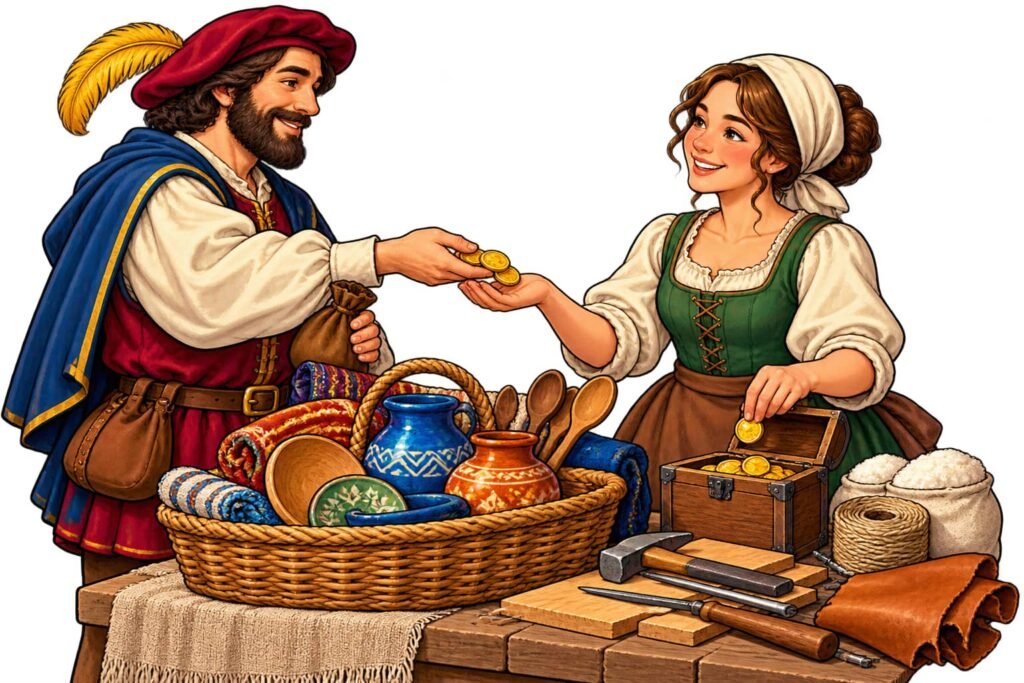
Smith traced one important reason to the human tendency to exchange and trade.
When someone discovers they’re good at making something, and that they can exchange what they make for other everyday necessities, they have a reason to specialize in that work.
A carpenter doesn’t have to grow all of their own food, and a farmer doesn’t have to make every tool by hand. Because they can trade, each has more opportunity to put their particular skills to use.
Today, when we exchange our labor for wages and then use those wages to buy food, housing, and services, the same interdependence is at work.
Smith used a comparison between humans and animals to explain this point. He argued that people could build cooperation far beyond the abilities of any individual through negotiation and trade. What matters here is his explanation of economic cooperation. We don’t need to treat the comparison as a complete account of animal behavior.
Exchange makes the division of labor possible. The division of labor improves productive efficiency. And a greater supply of products creates more opportunities for exchange. As the market expands, the process can develop further.
The growth of wealth is therefore connected to the way a society’s members cooperate.
But exchange immediately raises another question: how much of one good should you receive in return for another?
Why are some things extremely useful yet cheap, while others aren’t necessities but command high prices?
Smith posed a famous question using water and diamonds.
Water is essential to life. Yet where it is plentiful and easy to obtain, its price is often low. Diamonds aren’t necessary for survival, but they can be exchanged for large quantities of other goods.
To explore this difference, Smith distinguished between value in use and value in exchange.
Value in use concerns the needs something can satisfy. Value in exchange concerns how much of other things it can be traded for. The money prices we see every day are one way of expressing value in exchange.
The importance of water doesn’t directly determine the market price of every glass. How useful something is in our lives, and how much people are willing to give in exchange for it, are related but distinct questions.
Smith placed great importance on the role of labor. He sought to use labor as a measure of a commodity’s real value in exchange. He also explored how, in an early society before capital accumulation and private ownership of land, the labor needed to obtain different goods could affect the proportions in which they were exchanged.
If obtaining something generally requires more labor, people will often ask for more in return.
But it would be too simple to take this to mean that the price of every good is determined solely by the number of hours spent making it.
Labor already differs in the skills it requires, how strenuous it is, and the difficulty of obtaining the product. In more complex economic societies, Smith also brought wages, profits, and rent into his analysis of prices.
Mining, sorting, and processing diamonds require labor, while obtaining ordinary water is relatively easy in some places. That helps explain part of the difference in costs, but it can’t explain every price on its own.
Scarcity and buyers’ demand also affect exchange.
Modern economics makes a further distinction: the total contribution something makes to our lives is different from the additional satisfaction we gain from one more unit of it.
Where water is already plentiful, an extra glass may offer little additional benefit. But for someone in an environment with an extreme shortage of water, the value they place on that glass will be entirely different.
So understanding prices requires us to consider both the conditions of production and acquisition, and the particular conditions of supply and demand.
Smith also distinguished between natural price and market price.
By natural price, he meant a price high enough to cover the wages, rent, and profit on capital involved in producing and selling a good, at the usual rates in that place.
That includes an ordinary level of profit. When capital goes into a particular kind of production, it needs to earn an acceptable return compared with other uses, as well as recover the money spent.
The market price is the price at which a good actually changes hands. It can be higher or lower than the natural price.
If too few goods reach the market, and many people are both willing and able to buy them, competition among buyers can push the price up.
If the supply is too large, sellers may lower their prices to sell their goods more quickly.
Those price changes also affect producers’ decisions. A product that remains profitable will attract more investment. Production that keeps losing money will encourage some producers to cut back or move into other industries.
In Smith’s analysis, this process of adjustment gives market prices a tendency to fluctuate around the natural price.
But adjustment takes time, and it depends on conditions that allow competition. Monopolies, restrictions on entry, and obstacles to supply can all keep prices away from their usual level for a long time.
Smith’s discussions of labor, prices, and the distribution of income later had a profound influence on David Ricardo and Karl Marx. But their theories developed his ideas in different directions. We shouldn’t treat them as exactly the same explanation.
Talking about production brings us to a practical question. Before a factory sells its first batch of products, what do the workers live on? And where do the machines and raw materials come from?
This brings us to capital.
Suppose you want to open a pin factory and hire ten workers. The first batch of pins hasn’t been made yet, let alone sold. But you need a building, equipment, and materials. The workers also need enough to live on.
All these investments have to come before the sales revenue.
In Smith’s analysis, the more extensive the division of labor becomes, and the more complex the production process, the greater the need to accumulate supplies and funds in advance. These support people while they complete the work and get their products to market.
If everyone has to meet all their daily needs before they have any time or resources left for anything else, it’s hard to sustain a detailed division of labor.
Capital accumulation is therefore an important condition for expanding production and supporting the division of labor.
Smith divided a person’s stock of wealth into the part set aside for direct consumption and the part used to earn an income. The second part constitutes capital.
Food you keep at home to eat is for consumption. Machines and materials you plan to use in production to earn an income serve as capital.
Capital can then be divided into fixed capital and circulating capital.
Fixed capital can continue to serve production without needing to change hands through a sale each time it generates a return. Examples include machines, tools, factory buildings, and installations that improve land.
A machine can be used repeatedly, helping workers produce more goods. Its role is to keep improving the efficiency of labor over a period of time.
Circulating capital, meanwhile, needs to keep changing form or passing from one person to another to complete its cycle.
A factory buys raw materials. Workers turn them into products. Selling those products brings money back in, and that money buys the next batch of materials and supports the next round of production.
Raw materials, goods waiting to be sold, and the money needed to keep this cycle going all move continually between production and exchange.
Fixed capital and circulating capital also depend on each other. Machines can’t produce anything without materials. And having plenty of materials without suitable equipment also limits how efficiently you can produce.
When discussing money, Smith once again emphasized its role as a means of circulation.
Money makes it easier for people to buy and sell. But increasing its quantity alone can’t create a corresponding amount of food, clothing, and machinery.
Smith also considered the possibility of replacing some metallic money with paper money.
With reliable credit and arrangements for redemption, banknotes could handle some payments. Some of the gold and silver previously used in everyday circulation could then be used to buy materials or other means of production from abroad.
Under the conditions he envisioned, this substitution could reduce the resources needed to keep money in circulation and direct some of those resources toward production.
He was discussing the banking credit and monetary arrangements of his time. This doesn’t mean a country can create more real wealth out of thin air simply by printing more paper money.
Alongside different types of capital, Smith also distinguished between productive labor and unproductive labor.
Within his theoretical framework, labor was productive if its result could be embodied in a product that could be sold, with the sale recovering the investment and generating a profit.
Workers making goods and farmers producing food were among his main examples.
Other kinds of labor provide services as they happen, such as domestic service, performances, and medical treatment. In Smith’s classification at the time, these fell under unproductive labor.
That name is easy to misunderstand. Smith wasn’t saying these people were useless or shouldn’t be paid. He explicitly recognized that these services could have value and could be very important.
His concern was whether the result of the labor could be preserved in a saleable product and continue to support the reproduction of capital.
From the perspective of a modern economy, this classification has clear limitations. Healthcare, education, transportation, and other services can all meet needs, improve efficiency, and contribute to creating wealth. We can’t turn an eighteenth-century classification directly into a ranking of the value of today’s occupations.
With that distinction in mind, it’s easier to understand why Smith placed so much importance on accumulation.
In his analysis, if part of an income is used to buy tools, prepare materials, and support labor instead of being consumed immediately, it can increase capital.
With more capital, producers have the means to expand production, introduce a more detailed division of labor, and create more output. If some of the additional income goes back into production, it may support another round of growth.
This connects saving, investment, and production.
The thrift Smith praised was mainly directed against luxury and extravagance that eroded accumulation. The key is whether the resources saved can go into useful production.
If money simply sits idle without becoming an effective investment, or if an investment fails to meet demand, we can’t assume that spending less will necessarily make society richer.
Smith also discussed several main uses of capital.
Some capital goes into agriculture and the extraction of natural resources. Some goes into manufacturing. Some supports wholesale trade and transportation. And some goes into retail, distributing goods to consumers.
These activities work together. Agriculture and industry supply products. Wholesale trade and transportation connect different places. Retail allows people to buy according to their needs.
If the things people produce can’t reach the people who need them, a barrier arises between production and exchange.
Under the conditions of his time, Smith considered capital invested in agriculture especially important for supporting domestic output and productive labor. He also compared the different roles of agriculture, manufacturing, wholesale trade, and retail.
That ranking reflects his historical circumstances and his method of analysis. In today’s economy, we still need to look at the value a particular investment can create. We can’t simply apply his conclusion to every industry in every period.
The division of labor explains efficiency. Capital explains how production is supported. But a society has thousands upon thousands of different goods and countless different needs. Who coordinates it all?
This brings us to the most famous metaphor in The Wealth of Nations: the invisible hand.
When discussing the allocation of capital and restrictions on trade, Smith wrote that people usually think first about their own security and returns. They aren’t trying to arrange the growth of wealth for society as a whole, and they don’t necessarily know how much their choices will affect the public.
Yet under certain conditions, the actions they take in pursuit of their own interests may also advance the interests of society.
A baker may get up early to make bread primarily to earn an income. But to keep customers coming back, the baker has to think about taste, price, and quality.
The customer gets breakfast, and the baker earns an income. Neither needs to begin with a grand plan to improve society. Through the transaction, they can meet each other’s needs.
A taxi driver who wants to earn a fare needs to get a passenger to their destination. When rules and competition can do their job, safety, punctuality, and service quality also affect whether the driver can keep attracting business.
An entrepreneur seeking a profit may improve technology, reduce waste, and raise quality to make a product more appealing. Consumers gain more choices, while the production process also creates jobs and income.
What makes this work is the connection between people’s interests.
To get someone else to pay you, you need to offer something they’re willing to accept. When customers can choose another seller, businesses face pressure to improve.
Prices, supply and demand, and competition allow many separate decisions to influence each other.
Suppose demand for watermelons rises in summer, but there aren’t enough on the market for the moment. Prices may go up.
Higher prices can attract traders who bring in watermelons from elsewhere. They may also encourage growers to plant more in the next production cycle. Once supply increases, prices may change again.
Prices are conveying information here: where demand backed by spending has grown stronger, and where there may be an opportunity to increase supply.
But watermelons take time to grow. Transportation takes time, too, and people’s judgments can be wrong. If many growers expand at once, the next season may bring a surplus. So this adjustment goes through fluctuations. It doesn’t get everything exactly right every time.
A similar process takes place as capital and labor move into different industries.
Better prospects for profit may attract new investment. Persistent losses encourage businesses to reconsider how they use their resources. Competition also makes it difficult for firms to keep earning returns forever by doing things the same old way.
But turning the pursuit of personal advantage into mutual benefit requires certain conditions.
If a company can drive out all its competitors, consumers have no choice. If sellers can hide information and deceive buyers, or if some people can use power to secure special privileges, then pursuing their own interests can harm others.
Smith remained wary of merchants’ interests, monopolies, and special protection.
He didn’t reduce all human behavior to greed. Sympathy, justice, and concern for others also held important places in his moral philosophy.
To understand the invisible hand, we need to look at how the rules of exchange shape people’s behavior. When people pursue their own goals within the constraints of contracts, laws, and competition, their personal interests are more likely to connect with other people’s needs.
Following this line of thought, Smith went on to criticize the trade restrictions imposed under mercantilism.
If another country can supply cloth of suitable quality at a lower price, but the government keeps it out with high tariffs, domestic producers may be protected. Consumers, however, face higher purchase costs.
They could have bought more with the same amount of money. Instead, they have to pay more for costlier goods.
This protection can also influence business decisions. If a market is securely protected, firms may be able to stay in business even with high costs and low efficiency. That can weaken the pressure to improve technology.
And when one country raises trade barriers, other countries may retaliate. While some domestic industries gain protection, export industries may lose markets.
So when judging a policy’s effects, we need to consider consumers, other industries, and the costs borne by society as a whole, as well as the producers receiving protection.
Smith rejected the idea that trade is a contest in which only one side can benefit.
Different places have different resources, skills, and production conditions. Using labor and capital for activities they are relatively well suited to, then trading for other products, may allow both sides to get more.
Cloth and wine make this easy to see.
Suppose Britain has an advantage in producing cloth, while Portugal has an advantage in producing wine. If they can trade, they don’t have to bear the higher costs of keeping the production of everything within their own borders.
Britain can exchange cloth for wine, and Portugal can exchange wine for cloth. With suitable terms of exchange, both can expand their choices as consumers.
This illustrates the benefits of specialization and exchange. Later, Ricardo’s theory of comparative advantage took the argument further. Even if one country is more efficient at producing both goods, both countries may still benefit from trade, as long as the relative costs of producing the two goods differ between them.
Smith’s support for free trade is connected to this development of economic thought, but we need to distinguish his specific argument from Ricardo’s.
Supporting trade also doesn’t mean that every industry and every person benefits at the same time.
Cheaper imports may cause some local businesses to lose orders and may leave workers facing unemployment. The benefits to consumers and the disruption experienced by producers often fall on different people.
Smith believed that capital and labor could gradually move into other uses. But he also acknowledged that suddenly removing protection from an industry that had relied on it for a long time could cause considerable hardship.
He therefore discussed how restoring freedom of trade might sometimes need to happen gradually, giving the industries and workers concerned time to adjust.
For someone who loses a job, learning new skills, finding another position, and moving somewhere else all carry real costs. We can’t use possible future gains for society as a whole to pretend those costs don’t exist.
Smith also recognized exceptions to free trade that required careful judgment.
Industries important to national defense can’t be assessed solely on the basis of current product prices. He believed national security could matter more than increasing wealth.
Smith also discussed retaliation against trade restrictions imposed by other countries. But a key consideration was whether retaliation had a reasonable chance of persuading the other country to remove those restrictions. If it simply led both sides to keep escalating, consumers at home could suffer further harm.
Together with the issue of transition for protected industries, this shows that his position took specific circumstances and the process of adjustment into account.
If markets can coordinate so many activities, what responsibilities should government take on?
Smith outlined three major areas.
First, protecting society from violence and invasion from outside. In other words, national defense.
Without basic security, production and trade are difficult to sustain. When people can’t be sure their homes will remain safe, it’s also hard for them to plan investments for the long term.
Second, protecting members of society, as far as possible, from harm and oppression by others, through a fair system of justice.
Whether property is protected, contracts are enforced, and fraud and violence are kept in check all affect people’s willingness to cooperate, trade, and invest in production.
If the rules protect only a privileged few, while ordinary people can have the fruits of their labor taken away at any moment, markets will struggle to operate on fair terms.
Third, building and maintaining certain public works and public institutions.
Roads, bridges, ports, and canals connect production with markets, making transportation and trade easier. They can bring substantial benefits to society as a whole, even when private investors can’t earn enough from them to cover the cost.
In these circumstances, public authorities need to take responsibility and consider suitable ways to fund and manage these projects.
Smith was also concerned about education.
As we discussed earlier, the division of labor can improve efficiency. But he also recognized the limitations that highly repetitive work can place on people.
If someone spends years performing just a few simple actions, with almost no opportunity to think or learn on the job, the development of their abilities can suffer.
That’s why Smith argued that ordinary workers should also have access to basic education. The ability to read, work with numbers, and understand public affairs matters both to people’s own lives and to society as a whole.
These arguments show that, in his theory, markets depend on security, justice, and public institutions and infrastructure.
To carry out its responsibilities, government needs revenue. So what makes a good tax system?
Smith proposed four famous principles.
The first is fairness.
Members of society should contribute to public expenses according to their ability to pay. Smith linked that ability to the income people received under the protection of the state.
The public burden shouldn’t fall on just one type of income or one group of people. Nor should status and privilege allow some people to avoid their share indefinitely.
The second is certainty.
How much tax is owed, when it must be paid, and how it should be paid all need to be clearly defined.
If the amount depends on a tax collector’s decision at any given moment, people will struggle to plan their work and their lives. They will also be more vulnerable to extortion and unfair treatment.
Smith placed great importance on this certainty. It calls for clear rules and a sound basis for enforcement. Changes to the tax system should also follow clear arrangements.
The third is convenience.
The timing and method of collection should make it as convenient as possible for people to meet their tax obligations.
For example, when taxing income that arrives at regular intervals, it matters when people actually receive that income. Aligning tax payments with their ability to pay can reduce unnecessary hardship.
For someone earning income from agriculture, the situation after a harvest has brought in money can be very different from the lean period between harvests.
The fourth is economy.
Raising public revenue should impose as little additional burden as possible beyond the amount that actually reaches the treasury.
If collecting one hundred yuan in taxes takes a great deal of labor and expense, less money remains available for public purposes.
And the burden goes beyond the tax authority’s own expenses. Excessively complicated procedures, repeated inspections, and disruptions to normal production and trade also impose costs on society.
So, to judge whether a tax system is reasonable, we need to consider both how much the government receives and the total burden people bear to provide that revenue.
Fairness, certainty, convenience, and economy. These four principles connect public revenue with people’s everyday lives. They remind us to consider raising funds and protecting society’s productive capacity together.
Looking back, The Wealth of Nations keeps returning to the same question: how can people, through work and cooperation, make the things they need for life more plentiful?
The division of labor improves efficiency. Exchange connects different kinds of work. Capital supports ongoing production. And larger markets create the conditions for specialization.
Prices and competition influence how resources are used, while laws, public infrastructure, and education provide the support these activities need.
Working together, these relationships make the growth of wealth possible.
Smith’s theories also bear the marks of his time. Some of his arguments about value, service work, and the uses of capital need to be understood in their historical context. He didn’t answer every economic question that later generations would face.
But the questions he asked still carry weight.
When we see gold and silver, money, and figures on a balance sheet, we need to look further. Has society’s productive capacity improved? Are the things people need more plentiful? Can work and creativity earn a reward? Is trade fair, and are opportunities truly open?
A nation’s prosperity must ultimately reach the people who live in it.
When people can use their particular skills, exchange with one another, build up wealth with confidence, and cooperate under reliable rules, society has a better chance of turning limited time and resources into results that more people can enjoy.
That is a question still worth thinking seriously about as we return to The Wealth of Nations today.