Newsletter Subscribe
Enter your email address below and subscribe to our newsletter
Enter your email address below and subscribe to our newsletter

All voices matter
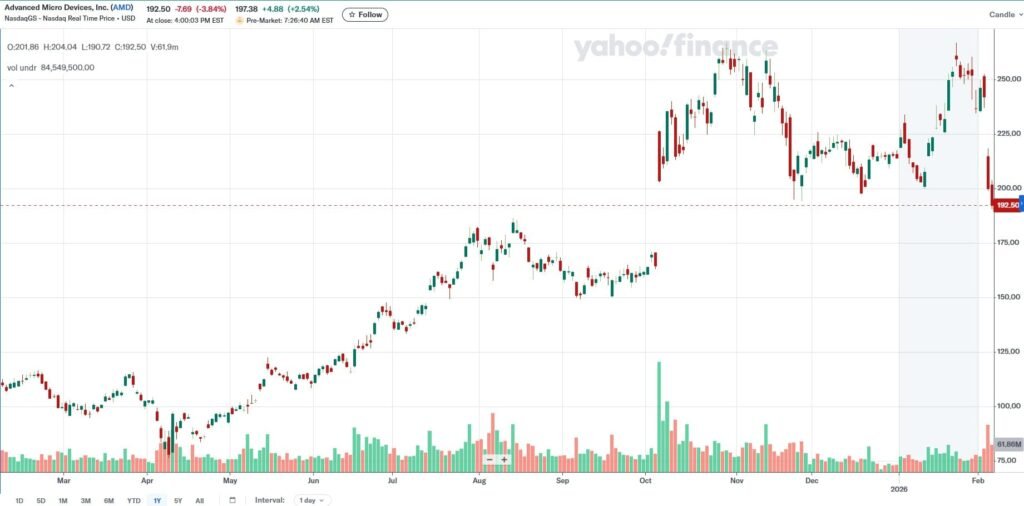
This week, AMD delivered a financial report that, on paper, looked like a triumph. Revenue crossed the historic $10.3 billion mark, data center sales surged by 39%, and earnings per share beat analyst consensus. Yet, the market’s response was a brutal execution: a 17% single-day collapse, erasing tens of billions in market cap.
To the retail observer, this looks like an irrational “sell-the-news” event or a “mispriced” buying opportunity. But if you believe the “overreaction” narrative, you are likely falling into a sophisticated cognitive trap. Behind the curated slides of CEO Lisa Su lies a masterpiece of financial cosmetics. Wall Street didn’t sell because they were panicked; they sold because they looked at the footnotes and realized the growth engine is stalling.
The headline boasted a non-GAAP gross margin of 57%. In the semiconductor world, that suggests immense pricing power. However, a forensic look at the 10-Q filing reveals that this margin wasn’t earned through product dominance—it was manufactured through two unsustainable “one-offs.”
AMD recognized $390 million from MI308 sales to China—a restricted chip specifically designed to skirt export controls. This wasn’t organic demand; it was “end-of-life” hoarding by Chinese firms fearing a total window closure. AMD’s own guidance for Q1 2026 shows this revenue cratering to $100 million. It’s a classic “pull-forward” of future earnings to save the current quarter.
The release of $360 million in inventory reserves is even more cynical. This is money AMD previously wrote off as “worthless.” Because of the sudden China rush, they sold the “trash” and booked the reversal as pure profit. It makes the wallet fat today, but it tells us zero about AMD’s ability to compete with Nvidia tomorrow.
In the 2026 AI era, the market has moved from the “Story Phase” to the “Verification Phase.” The cardinal sin in a high-growth sector is sequential deceleration.
AMD’s Q1 2026 guidance came in at $9.8 billion—a 5% decline from the current quarter. Management blamed “seasonal weakness in gaming consoles,” but Wall Street isn’t paying a 120x P/E ratio for a console cycle. They are paying for an AI moonshot. When Nvidia is growing at a triple-digit clip and showing no signs of stopping, a sequential drop from the #2 player is a signal that they are losing the “Growth Slope” battle.
To understand why AMD was crucified, look at Palantir (PLTR). Reporting in the same window, Palantir showed a 70% YoY revenue explosion and a massive acceleration in US commercial AI demand.
Palantir proved that real AI demand is insatiable. AMD proved that their demand is conditional. This created a psychological “anchor” for investors: if you aren’t showing a vertical growth curve like Palantir or Nvidia, you aren’t an AI leader—you’re a legacy chipmaker with an AI side-hustle.
The most painful realization for AMD bulls is the sheer scale of the gap between the “King” and the “Challenger.”
AMD’s entire year of effort is less than half of what Nvidia achieves in 90 days. AMD isn’t a peer to Nvidia; they are a “scavenger” picking up the overflow orders that Nvidia’s supply chain can’t handle. As Nvidia’s production capacity scales in 2026, the “crumbs” left for AMD will inevitably shrink.
AMD is currently trading at a valuation that requires it to consistently steal market share from Nvidia. The Q1 guidance proves they aren’t doing that.
Expert Take: AMD is an excellent company, but a mediocre AI investment at current valuations. The growth logic has been “falsified” by their own guidance. Until the stock finds a new valuation anchor—likely below its current levels—staying on the sidelines is the only disciplined move. In 2026, the market only rewards perfect execution. AMD just showed its first major crack.