
Newsletter Subscribe
Enter your email address below and subscribe to our newsletter
Enter your email address below and subscribe to our newsletter

All voices matter
The history of human progress is not a linear climb; it is a series of long stagnations interrupted by violent vertical leaps. If you compress the 5,000-year history of civilization into a single 24-hour day, almost every technological miracle we rely on today appeared in the final few seconds.
However, we are currently standing at the threshold of the most volatile transition in that timeline. While many look at the mid-2020s as just another era of “faster computers,” the data points toward something far more tectonic. 2026 is not just a calendar year; it is the “Event Horizon” for Silicon-based intelligence.
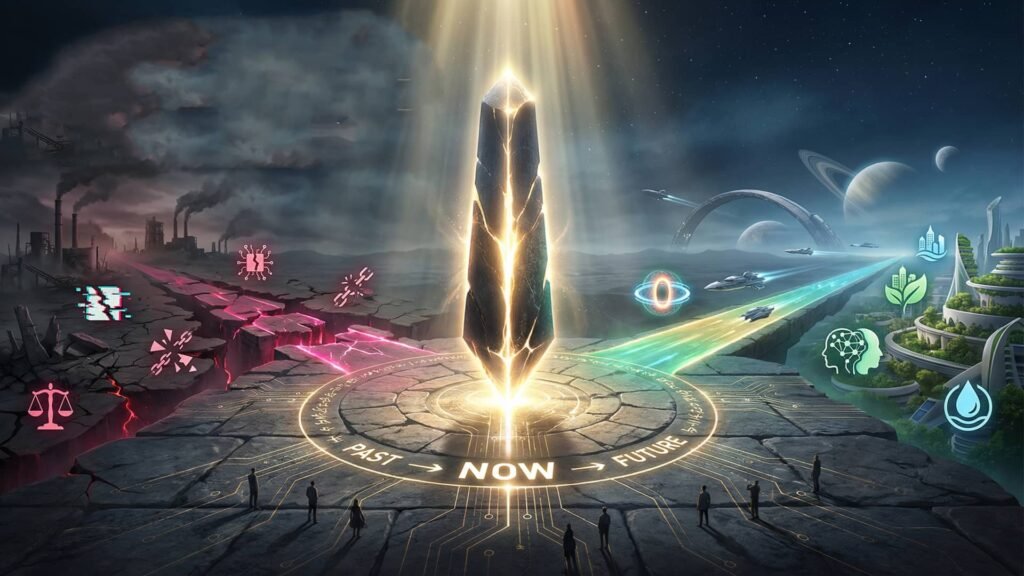
To understand why 2026 is the consensus “Epoch Date” among the elite circles of Silicon Valley and global capital, we must look at the convergence of three specific infrastructure curves: Compute, Model Reasoning, and Physical Embodiment.
| Pillar | 2024 State | 2026 Projection | Economic Impact |
| Compute Infrastructure | 100k GPU Clusters (H100/B200) | Multi-million GPU “Gigawatt” Clusters | Shift from training scarcity to inference abundance. |
| AI Architecture | Probabilistic LLMs (Text/Image) | AGI-Ready Reasoning Engines | Transition from “Chatbots” to autonomous agents. |
| Physical Agency | Prototype Humanoids / Geo-fenced FSD | Mass-produced Humanoids / Unsupervised FSD | Labor decoupling: GDP is no longer tied to human hours. |
Ilya Sutskever, the former Chief Scientist of OpenAI and arguably the “high priest” of modern neural networks, has shifted the conversation from if AGI (Artificial General Intelligence) will arrive to when. His departure to form SSI (Safe Superintelligence) was a signal to the markets: the “scaling laws” have not hit a wall; they have hit an accelerator.
The danger—and the opportunity—of 2026 lies in the verticality of the curve. We experienced this with ChatGPT. In 2022, AI was a novelty; by 2024, it was a utility. By 2026, the delta between a “helpful assistant” and a “self-evolving logic engine” will narrow to zero.
Sutskever’s recent focus on Conscious Alignment suggests that by 2026, we will no longer be coding software; we will be “parenting” a new form of digital sentience. This isn’t mysticism—it is the logical end-point of recursive self-improvement.
For decades, the software industry lived on “seats” and “subscriptions.” You paid for the tool, regardless of whether you succeeded with it. 2026 marks the official SaaS Sunset.
Driven by the fierce competition in the Asian markets and the efficiency demands of Wall Street, we are moving toward Outcome-Based Billing. * Old Model: Pay $50/month for a CRM.
If an AI agent doesn’t deliver a result, the cost is zero. This shifts the risk entirely onto the technology provider, forcing a massive consolidation. Companies that simply provide “interfaces” will go bankrupt; companies that provide “solutions” will capture the entirety of the market.
Elon Musk’s xAI is currently engaged in what can only be described as a “Blitzkrieg of Compute.” In Memphis, Tennessee, the speed of construction for the “Colossus” supercomputer has stunned traditional contractors.
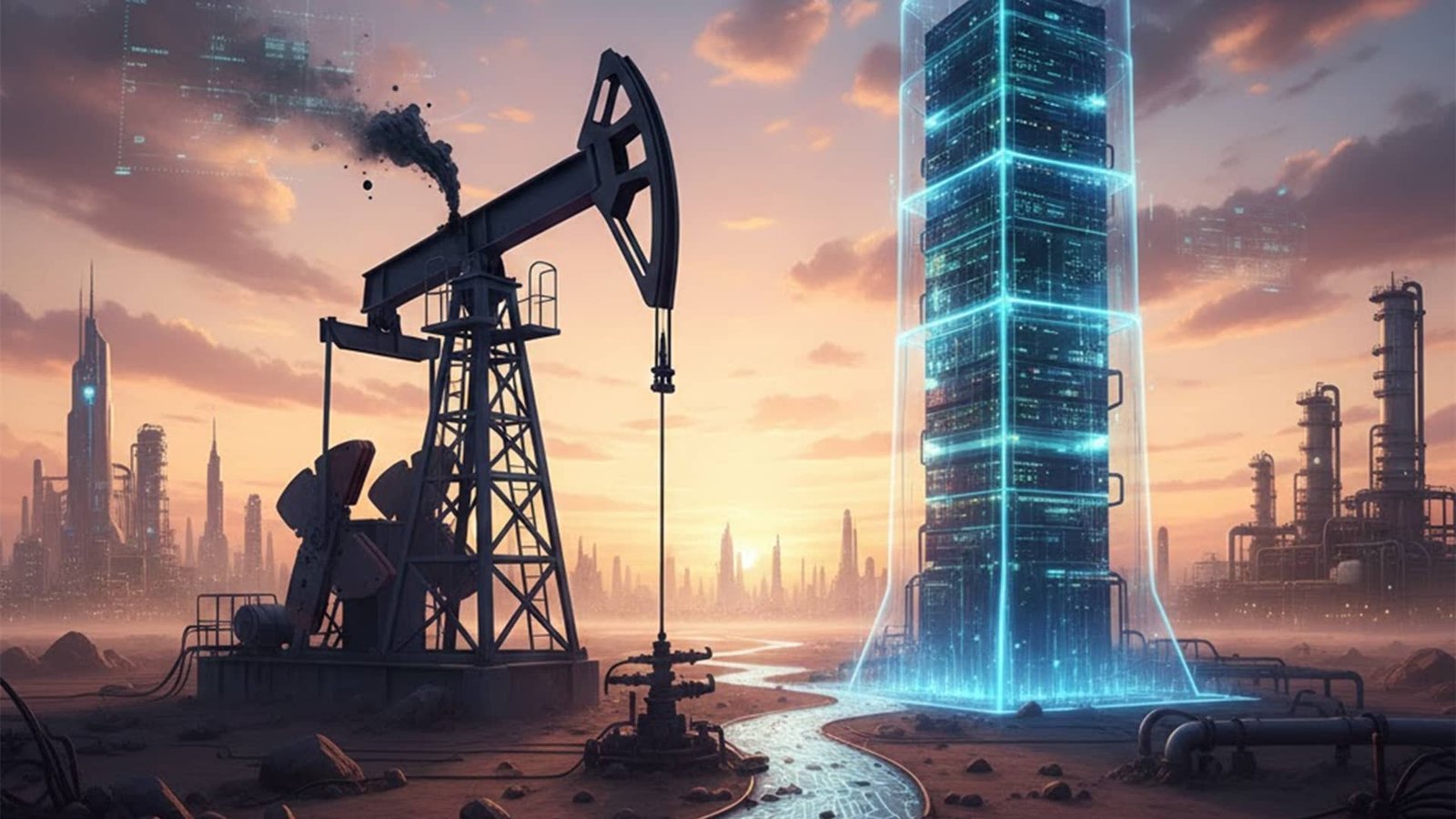
But why the rush for 2 Gigawatts of power? Because Compute is the new Oil. In 2026, the battle for truth will be fought via real-time inference. Musk’s Grok is designed to be a “Truth Engine” that bypasses traditional media filters by analyzing X’s massive data stream in milliseconds. When you have enough compute to simulate every outcome of a news event or a financial trade before it happens, you don’t just participate in the market—you define it.
Technological shifts always trigger geographic shifts. We are witnessing the Laffer Curve of Talent. As California and traditional tech hubs increase the “tax on genius,” the capital is voting with its feet.
The migration of figures like Peter Thiel, Larry Page, and David Sacks away from the West Coast is a precursor to the 2026 landscape.
With startups like Star Cloud testing GPU clusters in vacuum environments, 2026 will see the first “Extraterrestrial Compute Nodes.” Space offers perfect cooling (absolute zero) and infinite energy (solar), free from the regulatory bottlenecks of Earth-bound politics.
As we approach this “Super-Symmetry” point in 2026, the old career and investment playbooks are obsolete. To survive the transition from a Carbon-based economy to a Carbon-Silicon hybrid, focus on these three vectors:
2026 is the year the “PPT dreams” end and the “hard reality” begins. It will be violent for those clinging to the status quo, and “epic”—to use Musk’s word—for those ready to inhabit the future.




[…] The Great Decoupling: Why 2026 is the Hard Pivot Point for Human Civilization […]