Newsletter Subscribe
Enter your email address below and subscribe to our newsletter
Enter your email address below and subscribe to our newsletter

All voices matter
In January 2026, Finnish deep-tech company Donut Lab formally announced the commercial readiness of the world’s first fully solid-state battery platform capable of mass production. Unlike prior laboratory-scale demonstrations, this system is already integrated into a production vehicle program and backed by industrial-scale manufacturing capacity.
The announcement marks a critical inflection point for the global electric vehicle (EV) industry. For over a decade, solid-state batteries have been positioned as a “next-decade technology.” Donut Lab’s deployment challenges that narrative, introducing a battery architecture that materially outperforms lithium-ion cells across energy density, charging speed, durability, temperature tolerance, and safety—while eliminating reliance on scarce raw materials.
With the upgraded Worx TS Pro electric motorcycle scheduled for customer delivery in Q1 2026, this development represents the first verifiable case of solid-state batteries moving from promise to product.
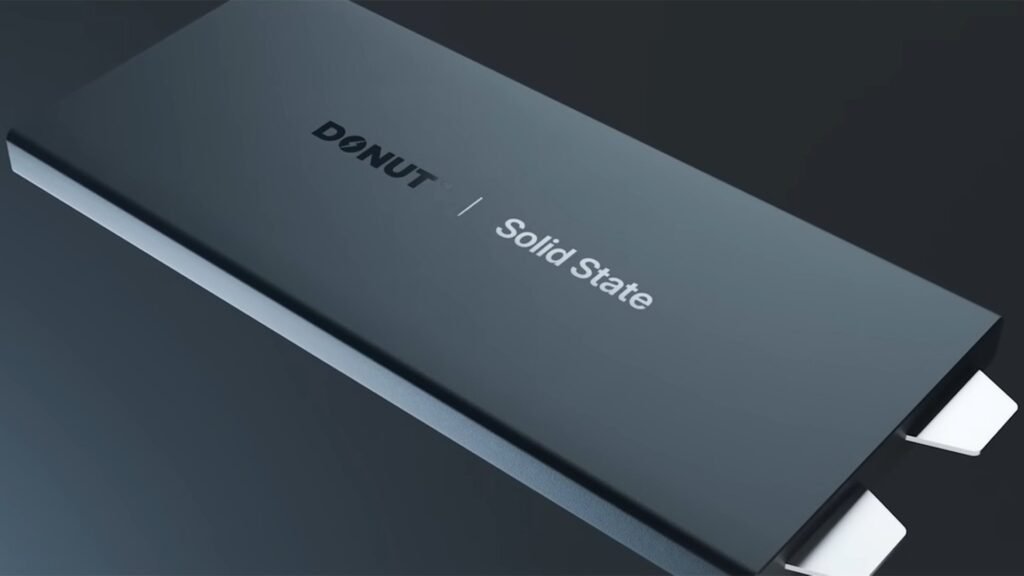
Donut Lab is a Finland-based advanced mobility technology company headquartered in Helsinki, with additional R&D operations in the United Kingdom. The firm is best known for pioneering high-efficiency in-wheel motor systems, which have been adopted in premium electric vehicle and performance mobility platforms.
The company’s core strategy centers on modular electrification architectures, allowing propulsion, energy storage, and control systems to scale across:
The solid-state battery marks Donut Lab’s most consequential expansion beyond drivetrain systems into energy storage, positioning the firm as a vertically integrated electrification supplier.
Unlike semi-solid or “hybrid” batteries that retain liquid or gel electrolytes, Donut Lab’s system fully eliminates liquid electrolytes. The battery employs a proprietary solid electrolyte and redesigned cell structure, paired with a purpose-built battery pack architecture optimized for thermal stability and mechanical resilience.
This is not a material tweak—it is a system-level redesign.
| Metric | Donut Lab Solid-State | Best-in-Class Lithium-Ion |
|---|---|---|
| Energy Density | 480 Wh/kg | 250–300 Wh/kg |
| Full Charge Time | ~5 minutes (100%) | 30–45 minutes (to 80%) |
| Cycle Life | ~100,000 cycles | 3,000–5,000 cycles |
| Operating Temperature | -30°C to +100°C | ~0°C to +45°C optimal |
| Capacity Retention (Extreme Temps) | >99% | Significant degradation |
| Fire / Thermal Runaway Risk | None (non-combustible) | Inherent risk |
| Rare Metals Required | None | Lithium, cobalt, nickel |
These figures are not incremental improvements. They represent order-of-magnitude gains in durability and safety, combined with a near-doubling of usable energy density.
One of the most disruptive aspects of Donut Lab’s battery is its true five-minute full charge capability, without the need to cap charging at 80%—a limitation common to lithium-ion systems due to degradation and safety risks.
From a user perspective, this reframes EV charging as a short stop rather than a planned activity, effectively removing one of the largest barriers to EV adoption across both consumer and commercial fleets.
With a certified cycle life approaching 100,000 charge-discharge cycles, the battery is engineered to outlast the vehicle itself.
For fleet operators and industrial users, this translates into:
This characteristic alone has major implications for heavy-duty EVs, where battery replacement is often the dominant long-term cost.
Because the battery contains no flammable liquid electrolytes, it does not ignite—even under physical damage. This directly addresses thermal runaway, the most serious safety concern associated with lithium-ion technology.
Equally important is what the battery does not require:
According to Donut Lab, the battery is manufactured from abundant, globally available materials, allowing production in virtually any region without exposure to strategic resource bottlenecks.
This is a meaningful advantage as governments and manufacturers seek to de-risk EV supply chains.
The upgraded Worx TS Pro, equipped with Donut Lab’s solid-state battery, serves as the first commercial validation platform.
| Configuration | Range | Charge Time |
|---|---|---|
| Lithium-Ion Version | 217 miles (349 km) | ~35 minutes |
| Solid-State (Standard Pack) | 217 miles | <10 minutes |
| Solid-State (Extended Pack) | 370 miles (595 km) | <10 minutes |
Notably, the extended-range configuration is achieved without increasing battery compartment volume, underscoring the advantage of higher energy density.
Worx has stated that the charging experience was intentionally designed around everyday user behavior—such as short stops at cafés—highlighting how fast charging alters mobility patterns, not just specifications.
For years, automakers have acknowledged solid-state batteries as the theoretical endpoint of EV development while simultaneously signaling that commercialization remained distant.
Donut Lab’s announcement—and more importantly, its production timeline—contradicts that assumption.
According to CEO Marko Lehtimäki, the technology is no longer waiting on “breakthroughs,” but rather on integration and execution. The Worx deployment demonstrates that solid-state batteries can already meet automotive qualification standards today.
Donut Lab has confirmed active commercial engagements across:
The battery’s extreme temperature tolerance, mechanical safety, and longevity make it particularly well-suited to mission-critical environments where lithium-ion cells remain problematic.
Donut Lab’s solid-state battery does not represent an incremental step in battery evolution—it represents a structural change in how electric energy can be stored, deployed, and scaled.
With verified mass-production capability, a live vehicle platform, and a supply chain model free from strategic materials risk, this development has the potential to accelerate EV adoption across segments that have so far remained on the sidelines.
For an industry long accustomed to waiting for “the next battery breakthrough,” this one has arrived—quietly, commercially, and ahead of schedule.